
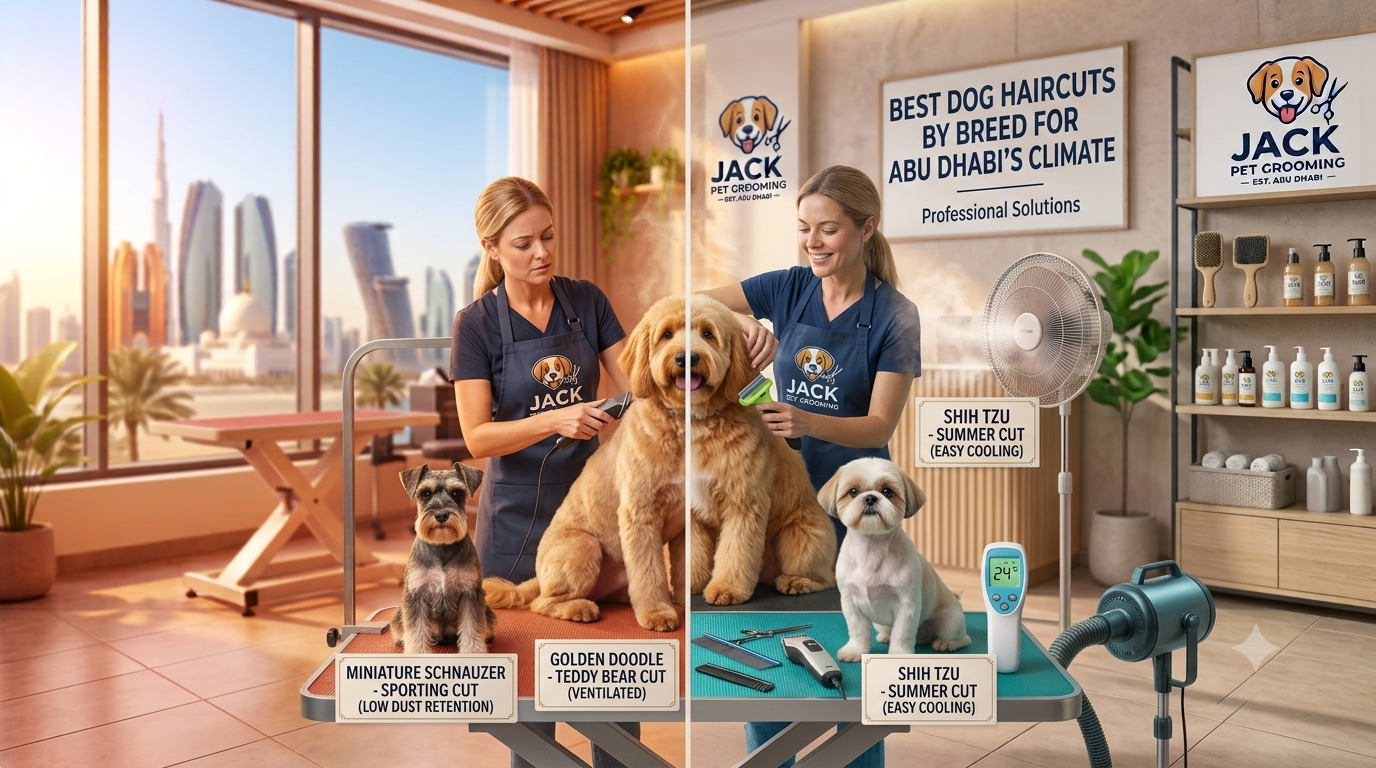
The best haircut for your dog depends on three factors: coat type, the maintenance you can commit to, and Abu Dhabi’s climate. For most long-haired and curly-coated breeds, a 2–4 cm Puppy Cut or Teddy Bear Cut is the most practical choice, as it reduces dust buildup, helps prevent heat-related matting, and is easy to maintain. Double-coated breeds (such as Labradors and Golden Retrievers) should not have their body coat clipped they benefit from regular deshedding instead. While breed-specific styles like the Poodle’s Continental Clip or a full Maltese show coat are possible, they require frequent professional grooming and are often impractical in Abu Dhabi’s hot, humid, and dusty conditions.
Why Dog Haircut Choice Is a Functional Decision, Not Just an Aesthetic One
Most owners choose a dog’s haircut based on how they’ve seen it look online or what the groomer suggests. In Abu Dhabi, this approach can lead to choices that look good immediately after the groom but create ongoing problems in the local climate.
Haircut choice affects:
- Matting speed longer cuts in humid conditions mat faster than shorter ones, particularly behind ears, under armpits, and around the collar
- Dust accumulation longer facial hair and leg furnishings collect Abu Dhabi’s fine dust rapidly, requiring more frequent cleaning between sessions
- Sun exposure shorter cuts on single-layer coats expose more skin to UV radiation; longer cuts on the same coats provide better coverage
- Grooming interval certain cuts require professional maintenance every 4 weeks to stay functional; others can comfortably stretch to 8 weeks
- Home maintenance burden a longer show-style coat requires daily brushing to prevent matting; a short puppy cut may need only 3-4 sessions per week
Understanding these trade-offs before choosing a cut saves both time and cost, and prevents the situation where a dog arrives at the groomer with severe matting that forces a much shorter correction cut than the owner wanted.
Dog Haircuts by Breed: Quick Reference
This covers the 10 breeds we see most commonly in Abu Dhabi, their recommended cuts, and specific local climate adjustments.
| Breed | Coat Type | Most Popular Cut | Abu Dhabi Recommended Length | Trim Interval | Key Risk if Delayed |
| Poodle | Curly / wool | Puppy cut, Teddy bear cut, Continental clip | Puppy cut at 2-3 cm — manageable in heat, prevents matting | Every 4-6 weeks | Severe matting, skin infection |
| Maltese | Long silky (single layer) | Puppy cut, Teddy bear cut, Show coat | Puppy cut at 3-4 cm — reduces dust accumulation on face and paws | Every 4-6 weeks | Eye irritation, facial matting, paw tangling |
| Shih Tzu | Long silky (double layer) | Puppy cut, Top knot, Lion cut | Short puppy cut — most practical for Abu Dhabi dust and heat | Every 4-6 weeks | Eye irritation from overgrowth, facial mat formation |
| Miniature Schnauzer | Wire coat | Traditional Schnauzer clip (furnishings kept, body clipped) | Body short, beard and leg furnishings maintained | Every 6-8 weeks | Coat texture loss, furnishings matting |
| Bichon Frise | Curly / wool | Round head cut, Puppy cut | Short overall — 2-3 cm — prevents humidity-driven mat formation | Every 4-5 weeks | Full body matting, skin irritation |
| Cocker Spaniel | Silky with feathering | Breed standard clip, Puppy cut | Body short, ears tidied — reduces dust accumulation in ear feathering | Every 6-8 weeks | Ear matting, ear infection risk from trapped dust |
| Golden Retriever | Double coat | Natural trim — feathering tidied, no body shave | Feathering tidied only — never shave body coat | Every 8-10 weeks for tidy | Matting in feathering, coat damage if body shaved |
| Labrador | Double coat (short) | No cutting required — deshedding treatment only | N/A — coat not trimmed | Deshedding every 6-8 weeks | Undercoat compaction, hot spots |
| Yorkshire Terrier | Long silky (single layer) | Puppy cut, Westie cut, Show coat | Short puppy cut — most manageable in heat and dust | Every 4-6 weeks | Facial matting, eye irritation |
| Pomeranian | Double coat | Natural round shape trim, Lion cut (controversial) | Light tidy only — never shave; double coat rules apply | Every 6-8 weeks for tidy | Coat damage, clipper alopecia if shaved |
Dog Haircut Styles Explained: What Each One Actually Means
Grooming terminology is inconsistent across salons and countries one groomer’s ‘puppy cut’ might be another’s ‘summer cut.’ Here’s what each style actually involves, and how suitable it is for Abu Dhabi conditions.
| Cut Style | What It Is | Best Suited To | Maintenance Level | Abu Dhabi Suitability |
| Puppy cut | Even length trim all over the body, typically 2-5 cm | Poodle, Maltese, Shih Tzu, Yorkshire Terrier, Bichon Frise | Low easiest style to maintain between sessions | Excellent most practical cut for Abu Dhabi’s dust and heat |
| Teddy bear cut | Similar to puppy cut but face is trimmed round for a soft, bear-like appearance | Poodle, Maltese, Shih Tzu, Bichon Frise | Low to medium face area needs more frequent tidying | Good popular in Abu Dhabi, practical length |
| Lion cut | Body shaved short, full mane left around head and neck, pom-poms on tail and ankles | Poodle (traditional), Shih Tzu, occasionally Pomeranian | Medium mane area needs regular brushing to prevent matting | Mixed body being short is practical, but mane area requires diligent brushing in humidity |
| Continental clip | Show-style Poodle cut specific areas shaved, pompoms left at joints and tail | Poodle (show standard) | High requires professional grooming every 4 weeks to maintain | Not ideal for Abu Dhabi high maintenance in dust and humidity |
| Schnauzer clip | Body clipped short, eyebrows and beard kept full, leg furnishings kept longer | Miniature and Standard Schnauzer | Medium — furnishings and beard need brushing 2-3x weekly | Good — but beard area collects dust and food and needs more frequent cleaning |
| Natural / feathering tidy | No body cut only feathering on ears, legs, belly, and tail tidied for neatness | Golden Retriever, Cocker Spaniel, Irish Setter | Medium feathering still needs regular brushing | Good for double-coated breeds where body coat should not be cut |
Breed-by-Breed Haircut Guide
Poodle
Poodles have a curly, single-layer wool coat that grows continuously without shedding. This makes regular professional trimming essential rather than optional — the coat doesn’t self-regulate through shedding the way double coats do, so it simply grows longer and denser until it mats. In Abu Dhabi, the puppy cut or teddy bear cut at 2-3 cm is the most practical choice for most owners. The Continental clip and other show styles look striking but require professional grooming every 3-4 weeks and daily home brushing to prevent the remaining longer sections from matting a demanding maintenance commitment in the local humidity.
Trim interval: every 4-6 weeks without exception. Poodles that miss their professional appointment typically arrive at the next one with matting that forces a shorter correction cut than planned. For more on managing Poodle coat care between sessions, see: How Often Should You Groom a Dog in Abu Dhabi’s Climate (link).
Maltese
The Maltese has a long, fine, single-layer silky coat with no undercoat. It’s one of the most visually striking coats in the dog world at full length, but also one of the most demanding to maintain. In Abu Dhabi, a full show coat on a Maltese is a daily grooming commitment the fine hair picks up every particle of dust, tangles at skin level with minimal provocation, and the facial hair requires daily cleaning to prevent eye staining and irritation from dust accumulation.
For most Abu Dhabi Maltese owners, the puppy cut at 3-4 cm is the most practical choice: it keeps the breed’s soft appearance, dramatically reduces home maintenance, and prevents the facial and paw area problems that Abu Dhabi’s dust creates with longer cuts.
For a dedicated breakdown of all Maltese cut options with their specific trade-offs, see: Choose the Right Maltese Dog Haircut Style.
Shih Tzu
Shih Tzus have a long double-layer silky coat unlike Maltese, they have a soft undercoat beneath the silky topcoat. This adds to the matting complexity since the undercoat can mat even when the topcoat appears brushed. The most common Abu Dhabi choice is a short puppy cut, which solves the dust and mat problems simultaneously. The top knot style where body hair is kept short but the facial hair is left longer and tied back is a middle ground between full short cut and full show coat, but requires daily attention to the top knot area.
The lion cut, where the body is shaved short and a mane is left around the head, is popular aesthetically but the mane area collects dust rapidly and needs brushing every 1-2 days to prevent matting in Abu Dhabi’s environment.
Miniature Schnauzer
The Schnauzer clip is the breed standard style: body clipped short, eyebrows left arched and full, beard and moustache kept long, leg furnishings (longer hair on legs) maintained. This style defines the Schnauzer’s characteristic look, but in Abu Dhabi the beard and furnishings require particular attention the beard collects dust and food debris rapidly and needs cleaning several times a week, and the leg furnishings pick up dust from outdoor surfaces and need brushing 2-3 times per week to prevent matting.
Some owners in hot climates choose to keep the beard and furnishings shorter than standard for easier maintenance this is a practical compromise that reduces the between-session grooming burden without losing the essential Schnauzer silhouette.
Bichon Frise
The Bichon Frise has a curly, fluffy coat similar in structure to the Poodle single layer, continuously growing, minimal shedding, high matting risk if brushing lapses. The classic round-head Bichon cut gives the breed its distinctive puffy appearance, but maintaining that shape requires professional grooming every 4-5 weeks. In Abu Dhabi’s humidity, the curly coat mats particularly fast between sessions, making daily home brushing non-negotiable. A shorter overall puppy cut reduces the daily maintenance demand while keeping the breed’s soft, rounded look.
Golden Retriever and Labrador
Both breeds have double coats that should not be cut. Golden Retrievers have feathering — longer silky hair on the ears, chest, belly, legs, and tail — that can be tidied at the edges for neatness, but the body coat should remain uncut. Labradors have a shorter double coat with no feathering and require no cutting at all. For both breeds, professional deshedding treatment every 6-8 weeks is the correct grooming intervention, not haircuts.
For the full explanation of why double-coated dogs should not be shaved or cut for cooling purposes, see: Does Shaving a Dog for Summer Keep Them Cooler?
Yorkshire Terrier
Yorkies have a fine, silky single-layer coat similar in texture to human hair it grows continuously, doesn’t shed significantly, and tangles easily at skin level. Full show coat Yorkies with floor-length hair are impressive but represent an extreme maintenance commitment that Abu Dhabi’s environment makes especially difficult. The short puppy cut is by far the most practical choice locally, keeping the coat at a length that’s manageable with 3-4 brushing sessions per week rather than daily attention.
Cocker Spaniel
Cocker Spaniels have a silky coat with feathering on the ears, legs, belly, and chest. The breed standard clip keeps the body coat short and neat while maintaining the longer feathering, but in Abu Dhabi the ear feathering requires particular attention it collects dust and traps moisture, creating an environment that can contribute to ear infections if not kept clean and dry. A slightly shorter ear feathering than show standard is a practical Abu Dhabi adaptation. Full coat to a puppy cut is also common for owners who prioritise low maintenance.
What to Tell Your Groomer Before the Cut
Many grooming disappointments come from a mismatch between what the owner imagined and what the groomer understood. Before any new cut, it helps to communicate:
- How much time you can realistically spend on home brushing per week this determines whether a longer style is sustainable
- How often you can bring the dog in for professional maintenance some cuts need monthly sessions, others work on 6-8 week cycles
- Whether the dog spends time outdoors in Abu Dhabi’s environment or is primarily indoors outdoor exposure significantly affects how fast dust accumulates in longer cuts
- Any sensitivities around the face, ears, or paws areas where cut choice directly affects comfort
- Whether you want the same style maintained or are open to a shorter, more practical cut if matting is present
Why Your Dog Sometimes Comes Back from the Groomer Shorter Than Expected
This is one of the most common frustrations owners share with us — they ask for a trim and the dog comes back much shorter. In almost every case, the reason is matting.
When a coat is matted close to the skin, the groomer cannot get scissors or a comb between the mat and the skin safely. The only option is to clip below the mat — which means the length is determined by where the mat is, not by what the owner requested. The longer the coat was kept between sessions without sufficient brushing, the more likely this outcome.
The solution is not to find a groomer willing to fight through the mats — this causes pain and potential skin injury to the dog. It’s to either maintain a coat length that the owner can genuinely keep up with between sessions, or increase professional grooming frequency so mats don’t have time to develop.
FAQ
What is the most popular dog haircut in Abu Dhabi?
The puppy cut is by far the most common choice for long-haired and curly-coated breeds in Abu Dhabi. Its even, short length across the body reduces dust accumulation, prevents matting in the local humidity, and is the most practical style for the between-session maintenance most owners can realistically commit to.
How do I know which haircut is right for my dog’s breed?
Start with coat type, not breed name. Single-layer coats (Maltese, Poodle, Shih Tzu, Yorkshire Terrier) can be trimmed to any length safely. Double-coated breeds (Labrador, Golden Retriever, Husky) should not be cut on the body at all. Wire-coated breeds (Schnauzer, Terriers) have specific clipping or hand-stripping options depending on whether coat texture preservation matters to you.
Can I request a specific haircut style even if my groomer suggests something different?
Yes — and a good groomer will explain why they’re suggesting an alternative if they do. The most common reason a groomer suggests a shorter cut than requested is matting that prevents achieving the requested length safely. If there’s no matting, your style preference should generally be achievable.
How often does a dog need a professional haircut in Abu Dhabi?
For curly and long silky coats, every 4-6 weeks is standard in Abu Dhabi — slightly more frequent than in cooler climates because local dust and humidity accelerate matting. Wire coats can stretch to 6-8 weeks. Double-coated breeds don’t need cutting but should have a professional deshedding session every 6-8 weeks.
Does a shorter cut mean less grooming at home?
Yes, significantly. A short puppy cut at 2-3 cm typically needs brushing 3-4 times a week. A longer show-style coat on the same breed may need daily brushing to prevent matting. In Abu Dhabi’s dust environment, the difference in home maintenance burden between a short and a long cut is even more pronounced than in cleaner climates.
Why does my dog’s coat grow back looking different after a groomer cuts it?
For single-layer coats (Poodle, Maltese), minor texture changes after cutting are normal and usually temporary. For double-coated breeds, significant texture or color changes after cutting are a sign of topcoat disruption one of the reasons groomers advise against cutting double coats at all. If the coat looks noticeably different after multiple groom cycles, it’s worth discussing with a groomer who specialises in your breed.
What’s the difference between a puppy cut and a teddy bear cut?
A puppy cut is an even length trim all over the body at a consistent length clean and simple. A teddy bear cut uses the same body length but adds a rounded, fluffy finish to the face, trimming it into a soft round shape rather than cutting it flat. The teddy bear cut requires slightly more skill around the face and may need face touch-ups between sessions as facial hair grows faster than body coat.